
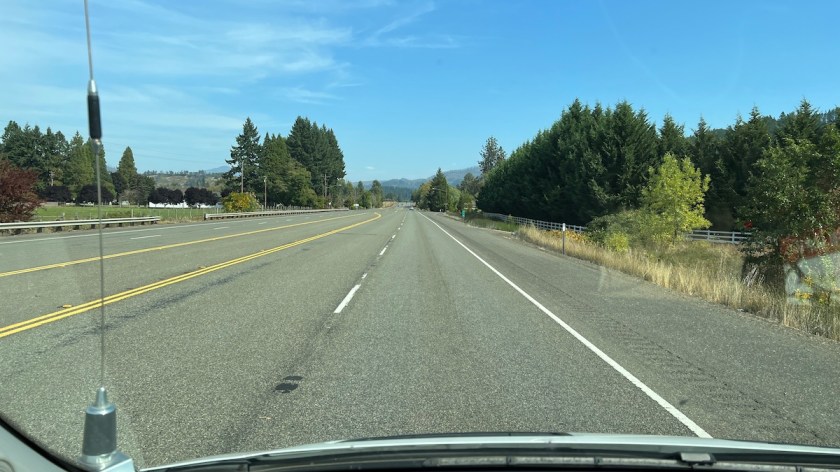
Yesterday I pulled up anchor, hitched up the trailer, loaded the bike, and hit the road, beginning my final leg of The Big Loop. Keith was kind enough to hook up his pressure washer so I could get the van and trailer all nice and shiny clean before I left. (I forgot to wash the bike. Whoops.)
The first part of the day’s trip was I-5 south to Roseburg. I needed to stock up on groceries, and there’s a WinCo there where the prices are excellent — or so I thought. Google Maps neglected to mention that this particular WinCo is closed. So I hit a nearby In-N-Out Burger to rethink my plans and research the area while I wasn’t driving.
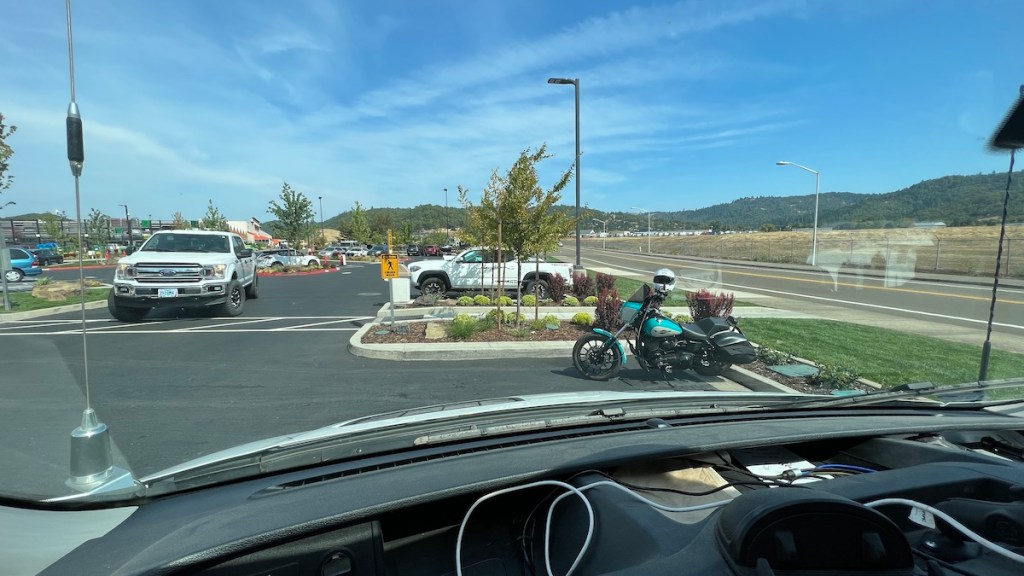
Parking was tight, and I hoped I wouldn’t be blocked in when I came out. The car in front of me had left, and this Harley had parked in a way that gave me tons of room to get out without coming anywhere near it. Thanks, Harley rider.
I filled up with the cheapest gas in town at a Speedway, a good 40¢ per gallon less than Safeway in Cottage Grove, which is the cheapest in town there. There was an Albertson’s in the same parking lot as the gas station, so I just went there to stock up on food. Then I followed the little blue line on Google Maps to Route 138, which would take me all the way to my destination.
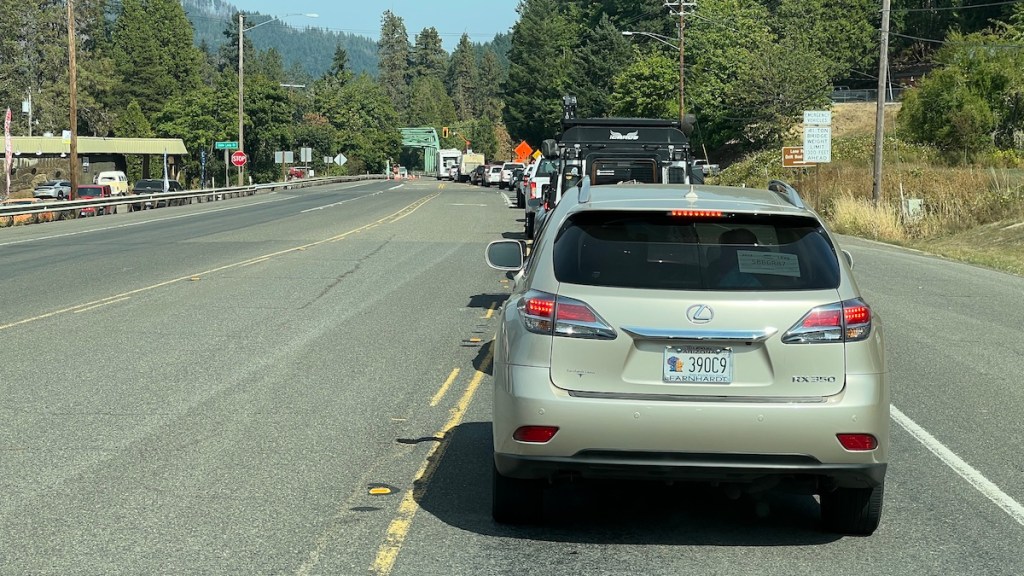
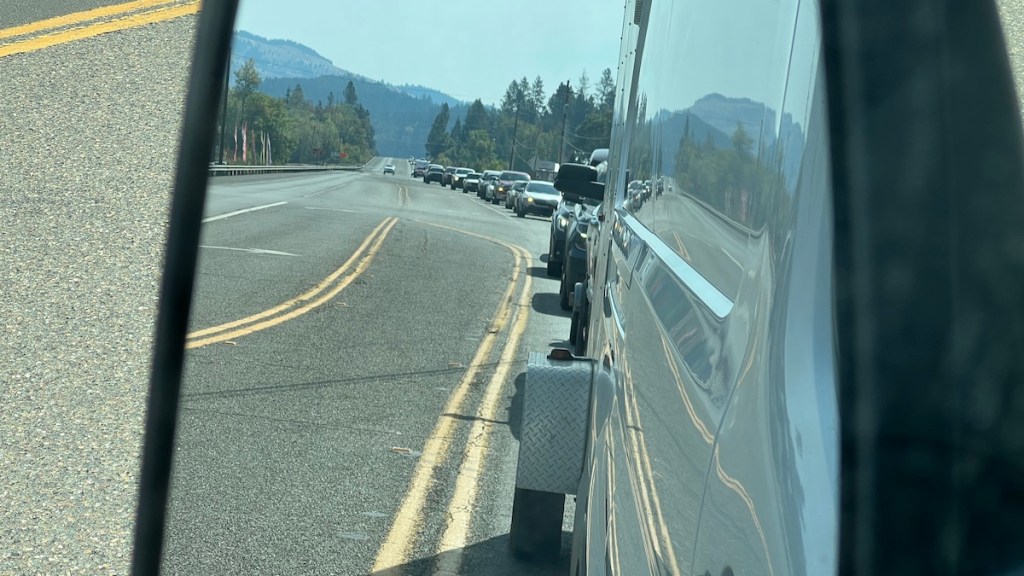
A little bit down the road, in the town of Glide, I found the most poorly timed construction traffic light in the world. A bridge was down to one lane, and the automatic signal let maybe two or three cars through at a time. Traffic was backed up quite badly, and it took me about 20 minutes to get through this quarter mile or so.
The rest of the drive was amazing. Route 138 runs along the North Umpqua River, and through the Umpqua National Forest. While the main reason I took the side trip to Roseburg was for the WinCo that turned out to be closed, it was also to put me on this road to avoid the closed area of the forest that I discovered on my motorcycle. Route 138 is the southern border of the area that’s closed, and I saw many closed roads to the north as I drove along. But where I was going was wide open, once I was past that awful construction traffic light.
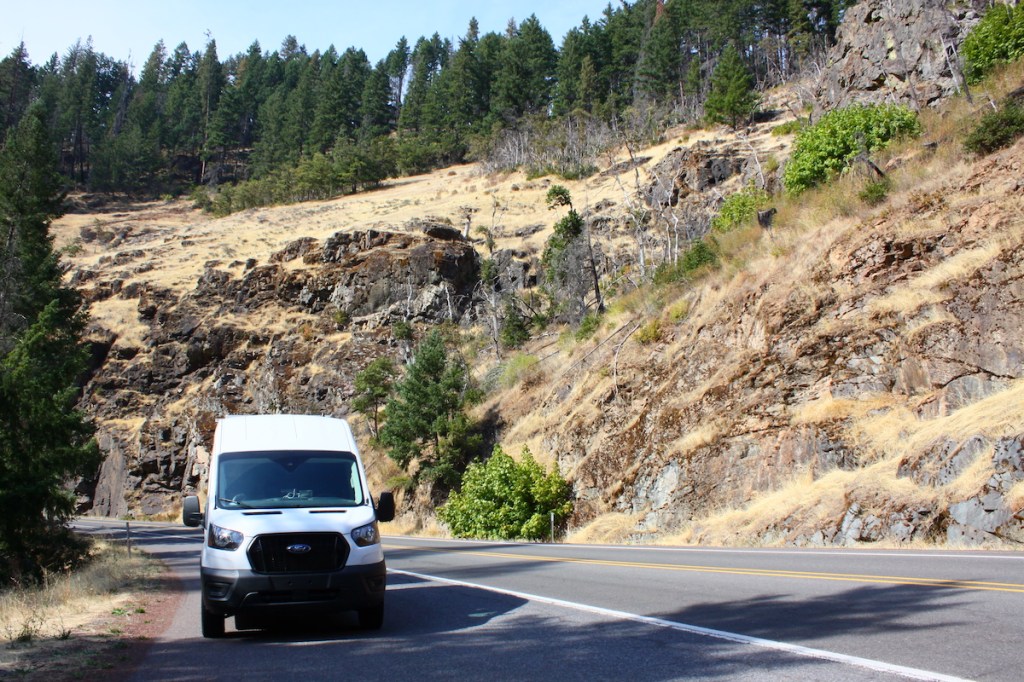
The scenery was amazing, about 60 miles of a mixture of green pine trees, brown and gray cliffs with dried-out grass, and blue water that turned white in the frequent rapids. There were a few parking lots marked specifically for raft launching and retrieval for people to ride the rapids. I’m not about to try that in my kayak. Besides, I haven’t taught Lister how to drive the van and pick me up at the other end.
My destination for the day was South Diamond Sno Park, which during the warm months is a free boondocking area. There were no signs marking it, so I ended up exploring a couple of paid campgrounds nearby. If I’d already been on the road for weeks I might have splurged for a night’s stay in one, but I’d just left, so I’m all stocked up for boondocking. I scrolled around the map a bit (my new Apple CarPlay unit in the van is working well, now that I’ve figured out its quirks), found the Sno Park and a few people already camped here, and found myself a nice spot to spend the night.
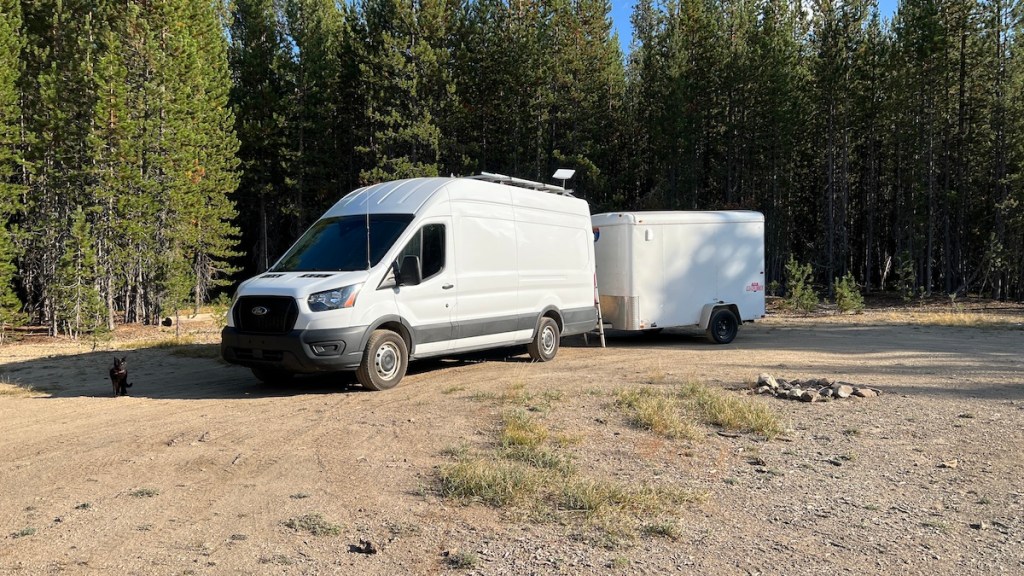
Cell service is weak and useless, but the clearing I’m in lets Starlink work. I’m not sure what I would’ve done without Starlink, because there isn’t a lot of cell service in this area, and I need to get some work done, as well as write posts about my adventures. I’m not allowed to use the fire pit, and that’s perfectly okay considering the wildfire danger. I had a quiet night, without waking up to chickens or my friends’ dogs being yelled at to come inside.
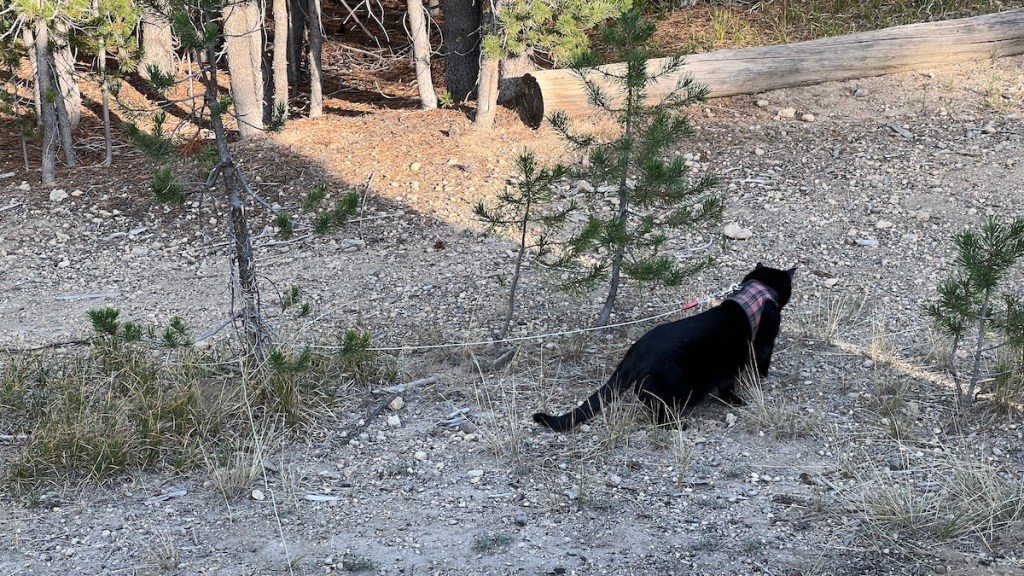
It didn’t take Lister long to get up to his old tricks.
It got chilly overnight, which isn’t surprising because I’m up over 5,000 feet elevation now. I woke up cold and turned on the heater. After a while, it gave me an E-05 error, which meant it overheated and shut itself down automatically. I turned the temperature down so it’s running at a lower output, not overheating, and I’m comfortable now. When I’m not parked on extremely dusty ground, I’ll have to crawl underneath the van to make sure the intake and exhaust aren’t kinked up, restricting airflow and allowing the temperature to get too high. This is also the first time I’ve used the heater at a higher elevation. It’s supposed to compensate for that automatically, but it’s entirely possible it may not. We’ll see.
It’s time for me to get some work done, and then move on to the reason why I’m in this area in the first place: Crater Lake National Park.
 Smokey Da Van