

I hadn’t bothered setting up Starlink here in the woods just south of Flagstaff, Arizona. We’re surrounded by trees, so of course it’s not going to connect very well. Cell service on both Verizon and T-Mobile was quite good, so there was no reason to set up Starlink — at least, until we suddenly lost ALL cell service at camp. It must be a problem at the tower. Unfortunately, that’s the tower we need to stay in touch with the outside world. Even worse, Yellow Wolf is on her way here and may need to contact us to guide her in if she can’t find the place.
I figured out which direction is north. Naturally, there’s a big clump of trees just to the north of my van. It’ll be a pain to move my van at this point since I’ve already set up camp for the week, so I removed the base that’s normally magnetically attached to the roof, and set up the dish with the best view to the north I could give it.
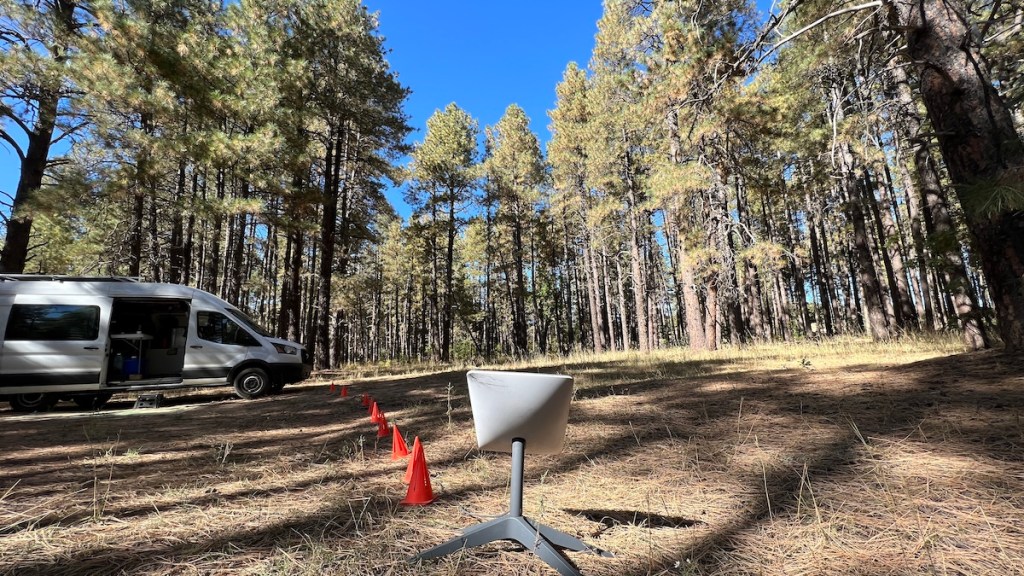
This isn’t great. In fact, it’s far from optimal. But Starlink did manage to connect, which is more than can be said for our current lack of cell service. Thanks to Wi-Fi calling, which lets phone calls and text messages come in through Wi-Fi, Yellow Wolf should be able to contact us if she needs to.

The speed isn’t great, nor did I expect it to be. It’s still fast enough for text and pictures. Videos are buffering a bit. It’s also losing connection from time to time because of obstructions, which is to be expected because we’re surrounded by trees.
Honestly, I’m impressed Starlink is doing as well as it is. It isn’t nearly as fast or reliable as cell service was, so I’ll be switching back to my hotspot once it comes back. But in a pinch, which we’re kind of in right now, it’s working well enough. That’s all I could ask.
Naturally, as soon as I posted this, Verizon service came back with full signal strength. T-Mobile is still out, but I’ve got a full month’s worth of data to use on my Verizon hotspot, so I switched over to that. The outage made for a good, challenging Starlink test, though.
 Smokey Da Van