
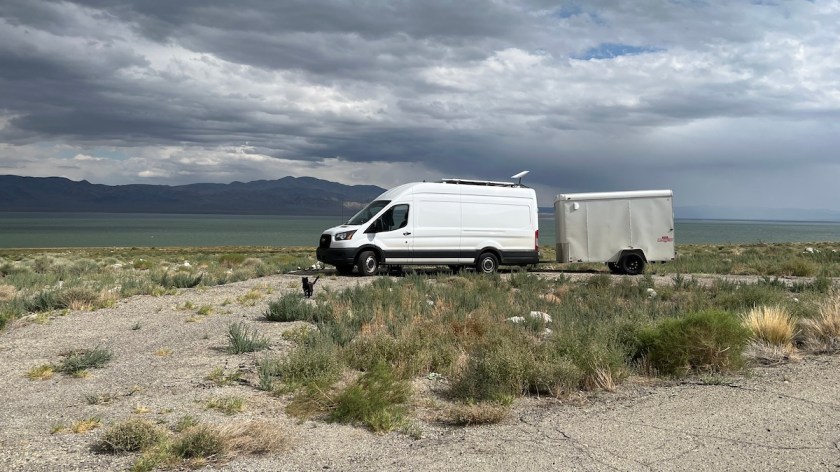
Yesterday I had the unfortunate experience of helping to talk someone out of pursuing life on the road. I know I write about its benefits and advantages all the time, but one thing a lot of people, including me, haven’t said much about is that not everyone is suited for this life. Obviously, many people simply don’t want to, and that’s perfectly fine. There is no one right way to live. In this case, the desire and enthusiasm were all there, but there were other factors working against it.
My friend Starr asked for my help in assessing the electrical needs of someone she was camping with, Roxy. Roxy is on oxygen. She had a small power station, a small solar panel, and two portable oxygen concentrators with their own batteries, but was running low on power. I could tell that Starr, a retired nurse, was trying to let Roxy down gently that she was ill-prepared to live out here, and that a second opinion would help. A subjective medical opinion is one thing, so I agreed to crunch the numbers and, as the song goes, blind them with science.
I examined all of Roxy’s equipment. It didn’t hurt that I actually worked for a durable medical equipment supplier in Maine for my last six months there, so I know a little bit about concentrators. I also know how to calculate volts, watts, and amps to determine power requirements. The power station was tiny, just 15 amp hours. The solar panel was 25 watts. The concentrators used 85 and 120 watts. There wasn’t enough power going in to offset the power coming out. Even if all the batteries were completely full, they wouldn’t even run for eight hours. Breathing is mandatory, and Roxy did not have anywhere near enough power or charging to sustain it safely.
Starr, my new neighbor Dalane (a former occupational therapist), and I had a difficult conversation with Roxy to convince her that despite her enthusiasm to be out here, her health and well-being were more important. It was emotional. She really wanted this. She bought a Ram Promaster City with a no-build build specifically to come to Quartzsite and find community after her remaining family had all passed away not too long ago. But she finally accepted the inevitable, that this trip, in this van, with this equipment, was not going to work. She needs a lot more power as well as backup power to do this safely.
Then Dalane said something brilliant. Roxy had said she wasn’t in this for the travel, but to find her people in the nomad community. Perhaps Roxy could bring the community to her. She has a house on a lake. People would love to come visit such a place for a day or three. She could offer it up on Boondockers Welcome, Hipcamp, and others, and meet other travelers. In the meantime, she could work on improving her van setup, either with a more robust solar and battery system or using shore power hookups to run her concentrators as much as she needs to, and still get to travel from time to time. Roxy latched onto that idea and loved it. Even though we essentially gave her bad news, she greatly appreciated our honesty, as well as Dalane’s redirection toward a more positive outcome that, while not exactly what Roxy wanted, could still get her some of what she was looking for.
As any celebrity does, Bob Wells has his haters and critics. The criticism I’ve heard most of him is that when he encourages people to sell everything they own, load up a van, and hit the road to live their best life, elderly single women in particular follow this advice, get out here, and find themselves in trouble. I didn’t take this criticism seriously before, but now I’ve seen a direct result of it, because that’s what led Roxy into this situation. She’s out several thousand dollars for the van and the drive across the country to Quartzsite. At least she still has the lake house to go back to, so she’ll have a roof over her head and reliable power for her oxygen.
I’m quite certain that Bob would not have personally recommended to Roxy that she hit the road the way she did under her circumstances. Knowing his generosity, he probably would’ve given her a giant power station and solar panels that would handle her concentrators with no problem. But the message to drop everything and hit the road is out there, and Bob is far from the only one to say it.
The decision to hit the road is not as simple as it seems. I understand the desire to “find your tribe,” as many people say out here. But as tempting as it is, it’s not worth doing if other circumstances, such as health or financial concerns, will be to your detriment. Roxy made an excellent point upon realizing that this wasn’t going to work for her. She didn’t want to be a burden on other people. None of us had told her that she would be, but that doesn’t make her statement any less true, and I diplomatically validated this for her. Also, medical attention isn’t exactly around the corner here in Quartzsite. It can take 10-20 minutes for an ambulance to get here, and it’s another 45 minutes to the nearest small hospital in Parker — certainly less while running lights and sirens in an ambulance, but still at least 30 minutes at higher speeds and running red lights. Most of the “Golden Hour,” after which the risk of death or long-term complications significantly increases, is taken up exclusively by travel.
While Roxy’s story doesn’t exactly have a happy ending, at least it’s a positive one. After this experience, I’m pretty sure there are some untold stories out there that did not end as positively.
 Smokey Da Van