

Suddenly, we spent about a week in southeast Texas for a family emergency. I won’t go into the details here because that story is not mine to tell. We didn’t explore or take pictures along the way because we were focused on the task at hand. However, I’m quite thankful to have a van that can sit for a few months and then instantly leap into action to make a 500-mile drive without worry.
As we passed through Heavener, Oklahoma, on the way there, Melissa mentioned that there was a park there that she had wanted to check out with some kind of runestone on display. That’s all she really knew about it, but it was enough to catch my interest as well. We didn’t stop on our way to Texas because we were in a rush, but we made a minor detour on our way back to check out Heavener Runestone Park. According to the website, this used to be a state park but is now owned by the town and managed by a non-profit organization. It offers hiking, camping, and an interesting historical relic, which was what we were there to see.
A short hike into the woods on a curated trail brings you to a valley surrounded by rocky outcroppings. Rudimentary stairs are a little tricky to descend but not difficult. The trail leads to a building in the middle of the valley constructed around an enormous stone with interesting markings carved into it.
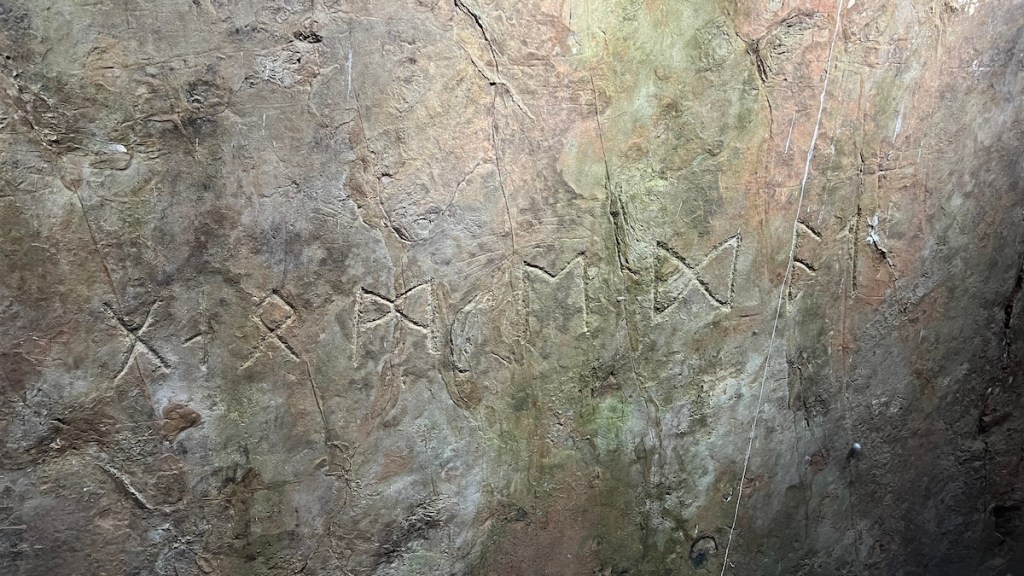
There have been numerous theories as to their origin over the years, but many historians now agree that they are Viking in origin, Elder Futhark that roughly translates to “Valley owned by Glome.” In other words, this is a land claim by a Viking named Glome.
It’s well established at this point that, contrary to what we were taught in school, the Vikings were the first Europeans to visit North America, not Christopher Columbus. L’Anse aux Meadows at the tip of Newfoundland is the first known Viking encampment here. It would not be surprising for them to have traveled beyond to the mainland, to modern-day Nova Scotia and New England. From there, it’s possible that they sailed all the way down the East Coast, around Florida, up the Gulf of Mexico, and up the Mississippi and Arkansas rivers to end up in Oklahoma, of all places.
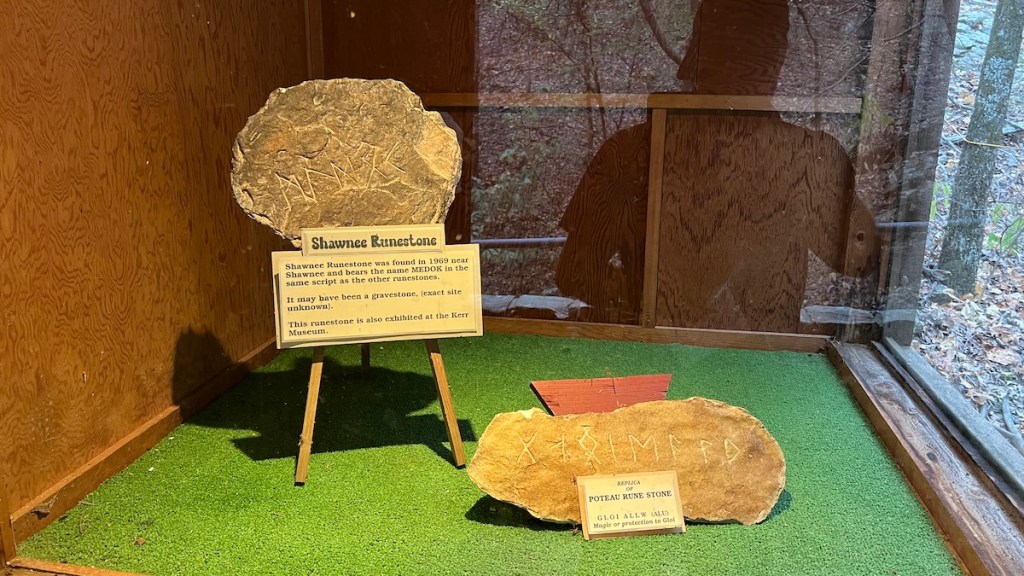
Many runestones like this have been found around the country. These two are replicas of other runestones found in nearby Shawnee and Poteau. However, there are still some historians who say these can’t possibly be of Viking origin, and must be Native American instead. Personally, I think these look far too much like Viking runes for their similarity to be a coincidence. The Vikings didn’t keep long-lasting historical records of their travels the way the major European powers did. They also weren’t into settling and colonizing the way England, France, Spain, Portugal, and others did later on. So we can’t really know for sure whether or not the Vikings made it to Oklahoma. I think that since we do know they made it across the ocean to North America, it is at least possible. They were wrong about Columbus being first, so they may be wrong about how far the Vikings explored, too.

Since some of the windows on the building surrounding the runestone are broken, it’s possible for birds to get inside. These two vultures sat on top of it during our entire visit, undisturbed by our presence.
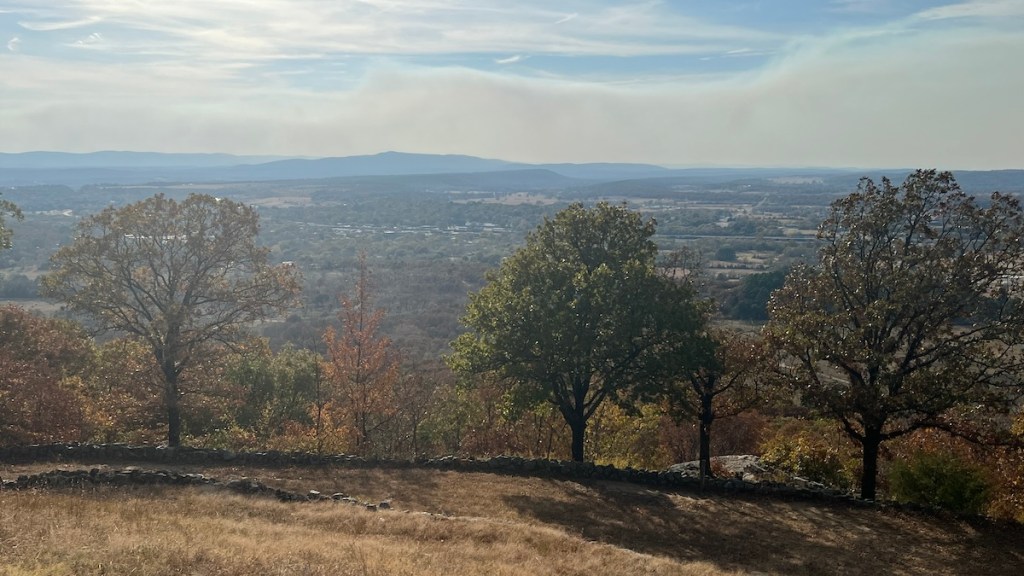
We also took a drive to the top of the parking lot to see the view of the town of Heavener from the overlook. It was a beautiful fall day, and fairly warm, though a bit windy. We could have explored the park more, but this was just a quick stop in the middle of an all-day 500-mile drive. Maybe we’ll explore a bit more some other time or even camp there at some point.
 Smokey Da Van