


It was a short drive to the north entrance of Crater Lake National Park. There was a short wait at the gate to get in. This sign made it crystal clear that I am not allowed to pull over and boondock inside the park. That’s a pretty standard policy across all National Parks. Fortunately, there are places where I can park overnight just outside the park both to the north and the south.
The ranger immediately handed me the brochure and sent me on my way after seeing my park pass and ID in my hand, without even taking them. She even thanked me for having them in my hand, ready to go. I figured I was just following the instructions on the sign, but that may be a rare thing for her. I pulled over at my first opportunity to read this info, familiarize myself with the place, and figure out where I wanted to go.
In a perfect world, I would’ve driven the loop roads all the way around the perimeter of the lake. I might’ve even found somewhere to park, unloaded the bike, and taken a pleasant ride around the perimeter. However, a section of East Rim Drive is closed for construction, making that impossible. I decided to stick to West Rim Drive, which would still take me all the way across the park.

Soon I left the thick pine forest and entered the Pumice Desert. It’s exactly what it sounds like, a desert of pumice left behind by the volcanic eruption 7,700 years ago that created Crater Lake. The eruption was 100 times more powerful than Mount St. Helens in 1980, causing what was left of the 12,000-foot Mount Mazama to collapse in on itself, creating Crater Lake. Ash from this eruption has been found as far away as Greenland.
Here, only a few miles away from Crater Lake, nothing living would have survived. Even now, the pumice that rained down on the area is inhospitable to most life, except the occasional pine tree.
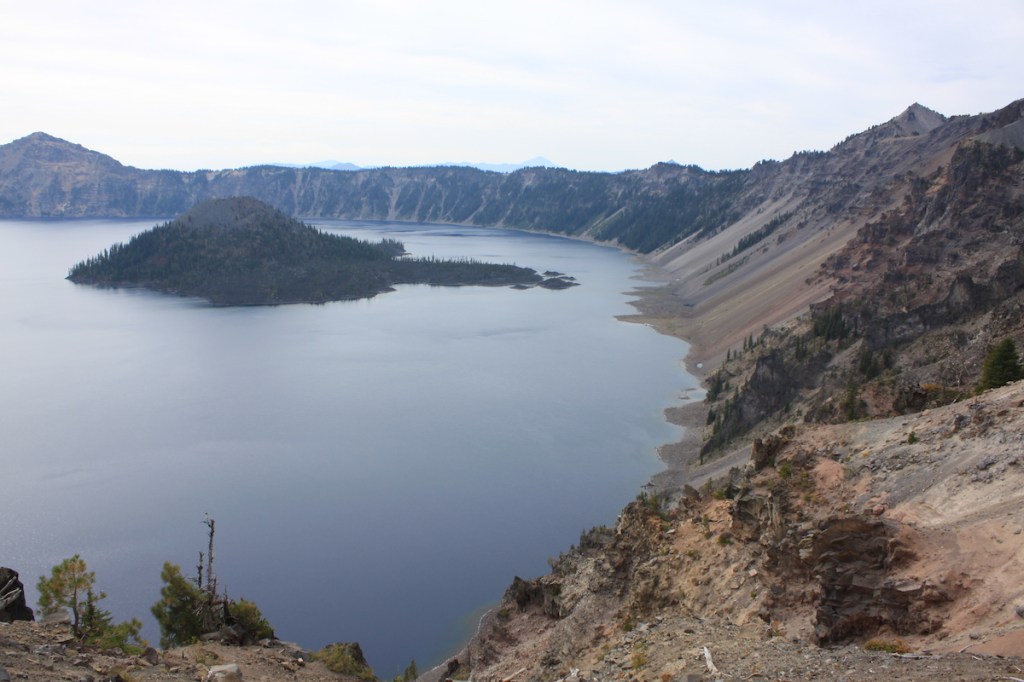
I pulled in at the first overlook I found, where the east and west rim roads meet, to get my first look at Crater Lake. It’s so big that it’s quite difficult to get the whole thing in a single picture. My Canon doesn’t have a wide enough lens to do it, and even my iPhone had a hard time. What makes this lake unique from most others I’ve seen is the steep drop-offs leading down to it. Those drops continue past the shoreline. At 1,943 feet deep, Crater Lake is the deepest lake in the US, beating Lake Tahoe by 300 feet. It’s also the deepest lake in the world formed by volcanic activity.
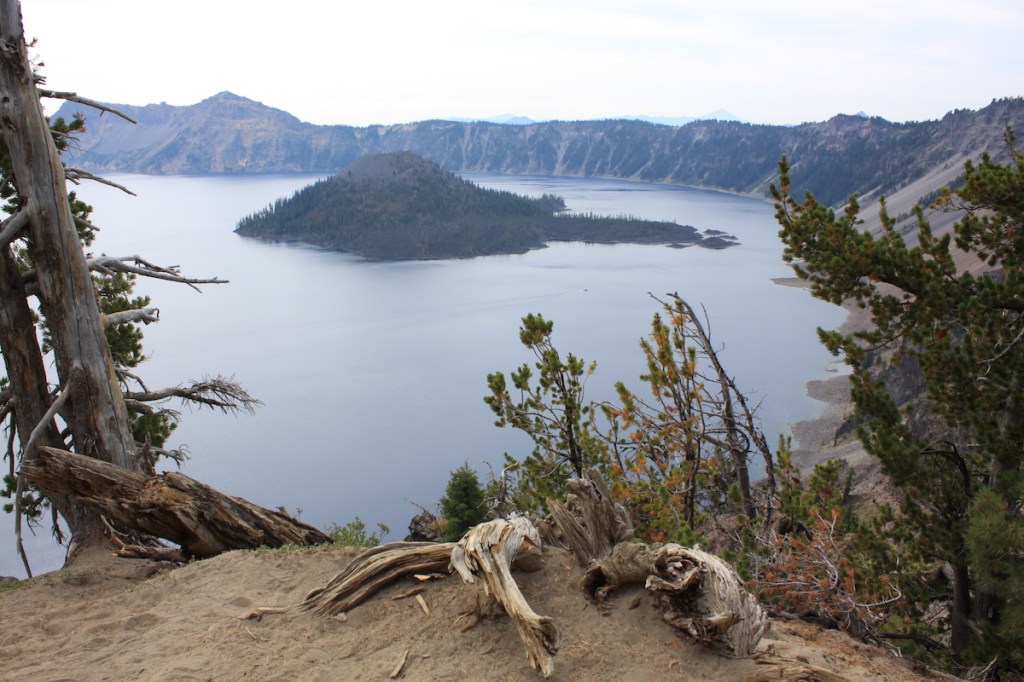
Off to one side of the lake is Wizard Island. This is literally a volcano within the volcano, having risen about 400 years after the big blast that created the crater. It sits 755 feet above the water level, and just shy of 7,000 feet elevation. No wonder I was a bit chilly as I looked down on it from the even higher edge of the lake.

Many other mountains, also former volcanoes, are visible in the distance. The sharp peak on the right is Mount Thielsen. In the distance behind it is South Sister, about 100 miles away. It’s one of the Three Sisters, which I had hoped to camp near again this year, but fires and smoke put an end to that plan.

Each overlook had a unique perspective to offer. It’s worth stopping everywhere you can to fully take in Crater Lake.
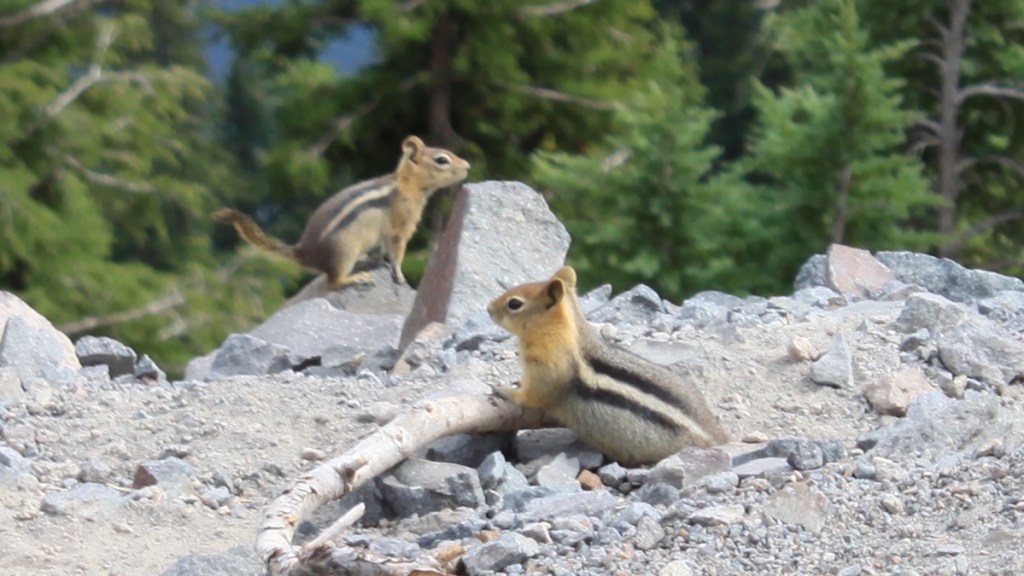
I noticed some movement nearby while taking the last picture, and managed to snap these chipmunks frolicking on the edge of the rim.
I tried to park at the visitor’s center, but there was nowhere to park. The lot is small, and the RV section was half full of ordinary cars taking up the extra long parking spaces I need. I circled the lot a couple of times, but traffic was terrible, so I gave up and continued on my way.

When East Rim Drive merged back in on the south side of the lake, I decided to take an adventure. There were many overlooks marked on the map, and I figured I could find a place to turn around. However, those overlooks weren’t nearly as frequent as the map had led me to believe. I started getting paranoid about not having a place to turn around with the trailer. As I passed Vidae Falls, I turned around at an intersection to play it safe.
Since I was there anyway, I stopped to take in the falls. I’ll bet it’s particularly impressive in the spring, with all the snow melting. Even now in mid-September, it was far more than just a trickle.
I rejoined the main road and soon exited the park through the south gate. To my surprise, there was another gift shop just outside the park, and the lot had plenty of room. I stopped in and got a sticker for my collection, something I haven’t been able to do for a while. Crater Lake was definitely worth adding.
A short drive later, I pulled into Annie Creek Snow Park. Unlike the previous night’s stay, this park has a large paved parking area with bathrooms along the side. A couple of campers were already set up there, complete with Starlink antennas. There is absolutely no cell service here, so I set mine up as well.
I took a short walk down the dirt road that continues past the main parking area. There are some wonderful campsites down there, including a few right next to Annie Creek itself. I’d love to park by the creek, but there are too many trees down there for Starlink to be able to connect. As it is, I had to move from the edge to the center of the paved lot to get a reliable connection.
I thought about unloading the bike and going for a ride down those Forest Service roads, but I was already pretty tired from the day’s excitement. I decided to just take it easy in camp for the rest of the day. I did open the trailer to check on the bike, and found that yet again two of the ratchet straps had come loose, letting it fall against my shelves on the side of the trailer. This is the second time that’s happened, so it’s time to get all-new ratchet straps, again. On a whim, I’d swung the mirrors in as I closed up the trailer when I left Cottage Grove. Nothing got damaged during this particular tip-over.
I did take advantage of the paved surface I parked on to verify that my heater intake and exhaust aren’t damaged or blocked, and to reattach the outdoor sensor for my thermometer underneath the van. Where I originally put it was close enough to the exhaust to give an artificially high reading when the engine or my heater is running, so I moved it to the other side of the van away from the exhaust.
It was 41º outside when I woke up and somewhere in the 50s in the van, so I turned on the heater. After a while, it shut down with error E-05 again, the overheating error. I let it cool down, turned it back on, and set the temperature low enough to not work it too hard, then slowly increased the temperature as it warmed up inside anyway. It works and will keep me warm, but it’s not optimum. I’ll have to do more research on this issue. I’m still at 4,100 feet elevation, so that might be a factor, despite this heater claiming to compensate for elevation changes. I never had this problem at 800 feet in Cottage Grove, or back in New Hampshire when I installed it.
I considered taking a detour down past Mount Shasta, California over the next few days, but the temperature is about to take even more of a dive up here this week, getting down to the low 30s. I seem to be making it over the mountains just in time before snow becomes a possibility. So I’ll stick to my original route, where the forecast says it will be a bit warmer as I continue southeast toward Nevada.
 Smokey Da Van