

Readers who have been here for a while know that my van life journey began on March 24, 2021, when an apartment fire forced me to move into my van before I was ready (hence, Smokey Da Van). Since then, like Smokey the Bear himself, I’ve been a bit of an advocate for fire safety, including making sure your home (whether on wheels or not) has all the necessary detectors, extinguishers, etc. Yesterday, such preparation seriously paid off.
Don’t worry. This incident had absolutely nothing to do with my van. It wasn’t even nearby at the time. I just happened to be in the right place at the right time to help someone else.
A few of us have been helping Melissa move everything out of one of her storage units to the barn at her house. Getting rid of that storage unit will significantly reduce her monthly expenses and help us start traveling again. Anyway, one of her friends has been a huge help, bringing her Ford Excursion and a 16-foot horse trailer to help move stuff. On the final trip yesterday, she was backing the trailer up the driveway to where we needed to unload. It’s a fairly steep hill, and the truck had to work pretty hard to do it. I’d noticed a little bit of smoke the last time she did this but figured it was because the transmission had worked too hard and briefly overheated. That was not the case. I was helping guide her up the driveway from the passenger side of the truck and suddenly noticed flames just behind the front wheel.
I yelled, “Stop! Fire! There’s a fire under your truck!” Calm and collected, she quickly put the truck in park, shut off the engine, and got herself and her daughter out safely. Melissa carries a small fire extinguisher in her 4Runner, and we ran to get it. I took it, pulled the pin while running back to the truck, and sprayed down the entire area. The fire went out. I kept a close watch for a little while in case it flared back up again, but the first spray was thorough enough to put it out for good.
My spotting the fire and fast thinking probably saved the truck, not to mention the trailer and everything inside it. We’re pretty far out in the backcountry, and even if they did everything perfectly, it would’ve taken the fire department a long time to get here. What really saved the truck, though, was that Melissa had a fire extinguisher in her 4Runner. (My van was a long way away up a steep hill. By the time I got it while the fire burned, it would probably have been too late.) Otherwise, we would’ve been scrambling to find water to pour on the fire. Depending on the type of fire, it might have put it out, or it might have made things even worse. As it turns out, the truck was leaking transmission fluid and possibly oil as well. My theory is that when she was gunning it up the hill, the fluid was under higher pressure than normal and sprayed out the leak more than just the usual light drip, straight onto the hot exhaust. This was the smoke we’d seen before, as well as the source of the fire. Pouring water onto an oil fire makes it spread much more quickly instead of putting it out, so the extinguisher was the right tool for the job. We unloaded the trailer, and the truck got towed to a shop for repair (after a six-hour wait, but that’s another story).
I was a believer before, but this event drove home to me that everyone should carry a small automotive fire extinguisher in their vehicle. You may never need it. I certainly hope you never need it for your own vehicle. In this case, we desperately needed it for someone else, and had one available that saved the day. Even if you don’t know how to use it, someone might be on the scene who does and can put your extinguisher (or first aid kit) to good use.
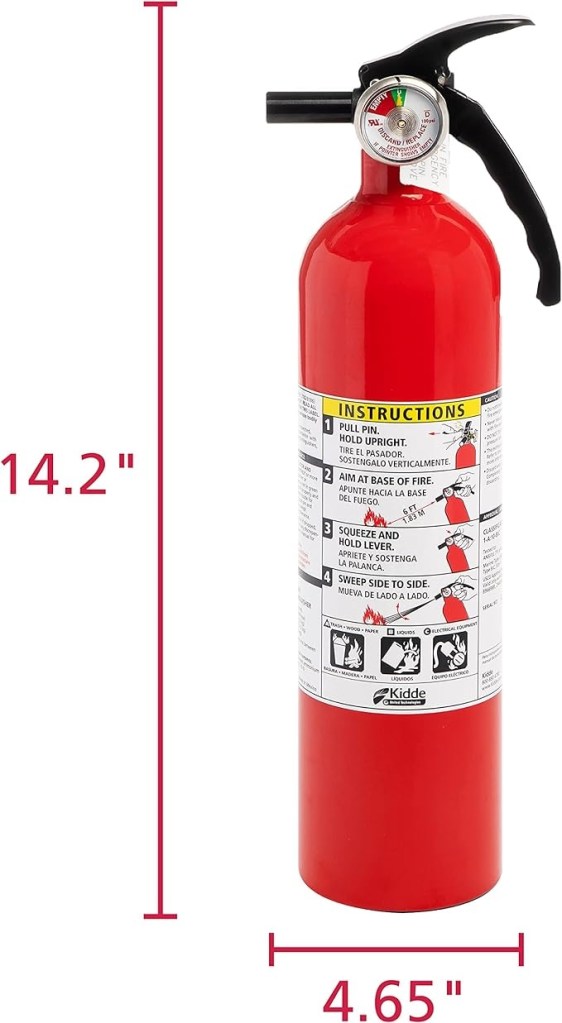
There are many different types of fire extinguishers available. This is the type I would recommend. It doesn’t have to be the Kidde brand linked here. I don’t even care if you use my Amazon affiliate link or not. What’s important is that it is a Type BC extinguisher. A standard household extinguisher is often a Type A, which is meant for “Fires in ordinary combustible materials, such as wood, cloth, paper, rubber, and many plastics.” These are what you have in a house, but not in a vehicle. A Type B extinguisher puts out “Fires in flammable liquids, combustible liquids, petroleum greases, tars, oils, oil-based paints, solvents, lacquers, alcohols, and flammable gases,” which is exactly what this fire was. Type C is for “Fires that involve energized electrical equipment,” which can also happen in any vehicle and almost happened in my van when a bad circuit breaker “let the magic smoke out.” A Type BC extinguisher is good for both types of fires, and perfect for automotive applications. A Type ABC would be perfect for van life since it’s both a vehicle and a home.
Extinguisher definitions from the National Fire Protection Association.
The bigger the extinguisher, the better, of course, but how much space it takes up in your interior is a concern. I’d recommend staying away from those tiny two-pound extinguishers, mainly because that’s simply not enough to fight a fire effectively. Melissa’s five-pound extinguisher was just about empty by the time I was finished putting out a relatively small fire, so that’s the minimum size I’d recommend. It’s also what I carry myself, though I’ve considered adding a second extinguisher in the back of the van.
That brings up another good point. Your extinguisher should be in as easily accessible location as possible, such as next to the driver’s seat. That way, you can grab it as you get out of the vehicle, or quickly reach in and grab it if you’re outside like we were. In my van, I mounted it to the back of the passenger seat mount. It’s almost as easy for me to reach from the driver’s seat, but I spend most of my time parked with the side door open, and it’s right there if I need it. I think I’d like to mount a second extinguisher in the back of my van, not just for additional capacity but also in case a fire happens at night while I’m in bed and I can’t reach the extinguisher up front.
Here’s a great video from Mighty Car Mods about how to mount an extinguisher in your vehicle. They’re coming at it from the perspective of driving on a race track, but it’s solid advice that can apply to anyone.


Regarding fire extinguishers, your April 30 post made me a believer. I’ve seen dozens of charred spots on highway shoulders, evidence that suggests nasty, car-destroying fires. After reading your post, I suspect that access to a fire extinguisher could have averted more than a few of those disasters. Purchasing fire extinguishers to keep in my car just became a priority.
LikeLiked by 1 person
Thanks! Even before the apartment fire, I was a believer. When I did courier work in Maine I happened to roll up on a car fire one day. I had an extinguisher in my work truck, so I pulled over to help. Unfortunately, the extinguisher hadn’t been maintained and didn’t work, so I got to see just how quickly the fire engulfed the entire car. The sooner you can put it out, the smaller and easier it will be to save the car.
LikeLike